
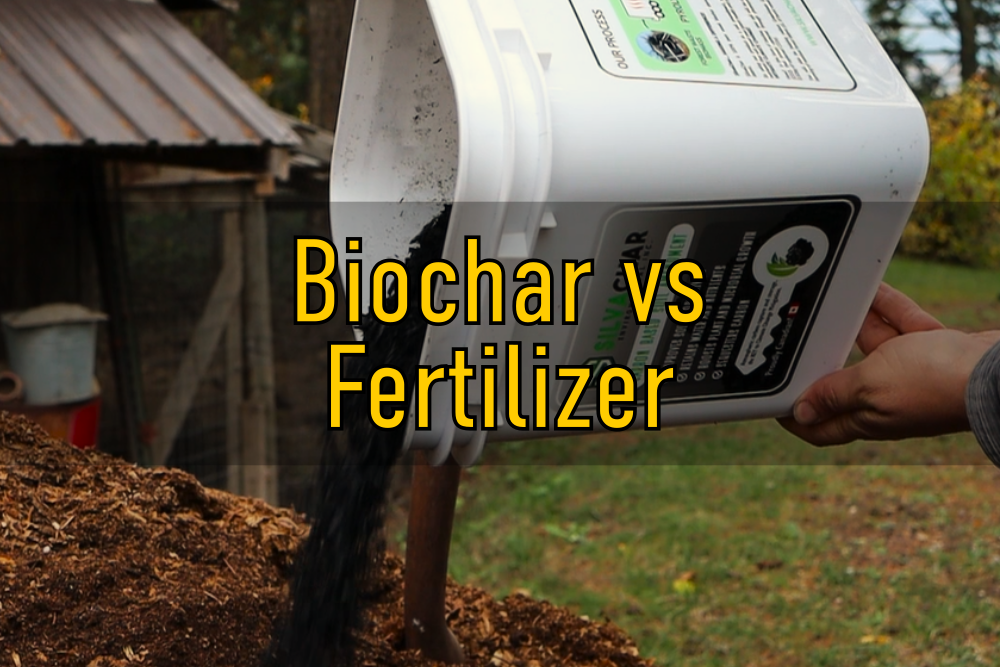
Can Biochar Replace Fertilizer?
Biochar does not replace fertilizer, but it can significantly improve how efficiently fertilizer works.
While biochar contains minimal plant-available nutrients on its own, it provides long-term structural benefits to soil. Fertilizers, by contrast, supply concentrated nutrients but offer little lasting improvement to soil structure or function. Used together, they create a more effective and resilient soil management strategy.
Biochar is a stable, carbon-rich material with an exceptionally high surface area and porous structure. This network of microscopic pores helps retain water, nutrients, and air within the soil, creating an ideal environment for plant roots and beneficial soil microbes.
Why Nutrients Get Lost in Soil
When fertilizer is applied without a retention mechanism, particularly in sandy soils or during periods of heavy rainfall or irrigation, valuable nutrients can move below the root zone through nutrient leaching.
This reduces fertilizer efficiency and increases the amount of nutrients lost before plants can absorb them.
Biochar helps mitigate this issue by holding nutrients within the root zone, slowing their movement through the soil profile and making them available to plants over a longer period.
Why Charging Biochar Matters
Before application, biochar should ideally be “charged” by blending it with compost, manure, liquid fertilizer, or another nutrient source.
Because of its high absorptive capacity, raw biochar may initially bind available nutrients from the surrounding soil if applied uncharged. Pre-charging saturates the pore structure in advance, transforming biochar into a nutrient-rich carrier that supports immediate plant uptake rather than temporarily competing for nutrients.
Practical Application in Soil
For gardens, raised beds, lawns, and greenhouse systems, a common recommendation is to incorporate charged biochar at approximately 7-10% of total soil volume (top 10cm). This rate typically provides meaningful soil improvement without disrupting overall soil balance.
Particle size should also be considered:
• Fine biochar is generally best suited for sandy soils, where increased surface contact improves nutrient and moisture retention.
• Coarser biochar can be advantageous in clay-heavy soils, where larger particles help improve aeration and soil structure.
How Biochar Supports Soil Biology
Healthy soil depends on active microbial communities to convert nutrients into plant-available forms.
Biochar’s porous structure provides protected habitat for beneficial microbes, allowing them to colonize and remain active within the soil. These microscopic spaces offer shelter, moisture retention, and stable growing conditions for microbial populations.
Growers frequently observe improved moisture retention in biochar-amended soils as well, which can reduce drought stress and promote more consistent plant performance during hot, dry conditions.
Long-Term Benefits of Biochar
Unlike compost or fertilizer, which decompose or move through the soil over time, biochar remains stable for many years after application.
Research from Cornell University and other institutions has demonstrated biochar’s potential to improve nutrient retention, water-holding capacity, and long-term carbon stability in soil. For growers, this means biochar is not a replacement for fertilizer, it is a long-term soil amendment that helps maximize the effectiveness of every nutrient input.
Final Takeaway
Biochar works best as part of an integrated soil management strategy.
When properly charged and combined with fertilizer or organic amendments, biochar can:
• Improve nutrient retention
• Increase water-holding capacity
• Enhance microbial activity
• Support long-term soil structure
• Improve overall fertilizer efficiency
At Silvachar, we recommend blending biochar with compost, manure, or fertilizer prior to application for best results.
Silvachar biochar is designed to be mixed with compost,
manure, or fertilizer before application for optimal results.
About the Author
Kevin Smith
Silvachar VP
RPF

No responses yet